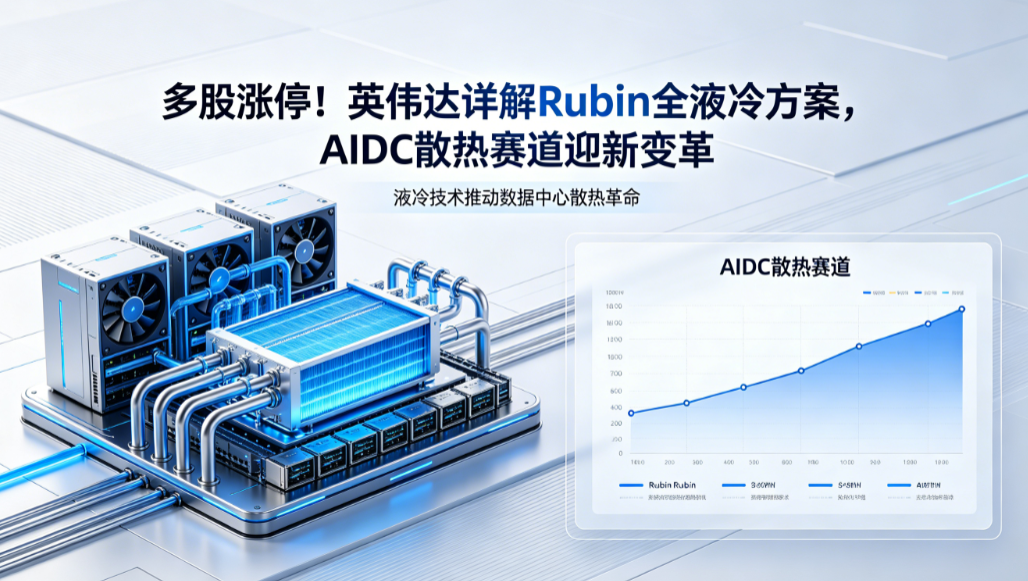
NVIDIA Rubin Sparks Liquid Cooling Sector: Industry Revaluation and Investment Themes Under AI Computing Upgrade
Keywords: Liquid Cooling Concept, NVIDIA Rubin, AI Data Center, AIDC, East-West Computing Transfer, Computing Infrastructure, PUE, Industry Chain
Introduction
On the morning of June 23, liquid cooling concept stocks strengthened again. Fang Sheng Shares led with a 30cm limit-up, while Shengyang Shares, Dayuan Pump, Satellite Chemical, and Tongyi Shares also hit daily limits. Shuguang Digital, Intellitech, Envicool, Weilong Shares, and others rose in tandem. The market sentiment is not just thematic rotation but NVIDIA's full liquid cooling solution on the Rubin platform, which is driving a substantive revolution in AI data center thermal technology. As high-computing chips continue to iterate, traditional air cooling can no longer meet the demands of high density, low energy consumption, and high reliability. Liquid cooling is accelerating from an "optional solution" to an "infrastructure essential."
1. Rubin Platform Deployment: Liquid Cooling from Auxiliary to Core
On June 21 local time, NVIDIA detailed its 45°C full liquid cooling technical solution for the Rubin platform via its official blog. As the world's first AI computing platform to achieve 100% liquid cooling, Rubin is scheduled for volume shipment this fall. This means the data center cooling system will move from the past transitional stage of "air cooling dominant, liquid cooling auxiliary" to a new stage of "full liquid cooling, fan-free, and hose-free."
From a technical perspective, Rubin abandons traditional mixed air-liquid cooling. Chips and network components rely entirely on liquid cooling, with no internal fans. It uses 45°C high-temperature coolant, microchannel cold plates, and a 75% water + 25% propylene glycol mixture. Compared with previous schemes, this design offers clear advantages: first, liquid heat exchange efficiency is far higher than air, capturing chip heat more effectively; second, system noise is lower and structure simpler; third, rack density significantly improves—systems requiring six rack units previously can now be compressed to two, vastly improving data center space utilization.
More importantly, Rubin is not just about "removing heat" but also about energy efficiency. The 45°C coolant allows heat to be captured directly at the chip and transmitted through a higher-temperature liquid circuit to outdoor dry coolers, reducing mechanical cooling demand and facility water usage. Under suitable climate conditions, cooling water consumption can drop from about 2.6 million gallons per megawatt per year in traditional tower systems to near zero, and PUE can potentially decrease from 1.35 to 1.15. This shift means liquid cooling is no longer just a performance optimization tool but a key technology for data center energy-saving compliance.
2. Policy Constraints Coupled with Computing Demand, Liquid Cooling Penetration Rate Rises Rapidly
The liquid cooling track is favored by the market not only due to technological upgrades but also because of the dual resonance of policy and demand. China's "East-West Computing Transfer" project requires new large data centers to control PUE below 1.25. Major cities like Beijing, Shanghai, Guangzhou, and Shenzhen impose higher requirements for liquid cooling racks in new intelligent computing centers, with some areas requiring over 50%. Against the background of traditional air cooling PUE often above 1.5, liquid cooling has almost become a practical path for intelligent computing centers to pass energy consumption approval.
This means the growth logic of the liquid cooling industry has shifted from "technology pilot" to "large-scale deployment." As AIDC enters a phase where large model training and inference are equally important, computing density continues to rise, and single-rack power consumption climbs. The cost, energy consumption, and reliability of the cooling system will directly affect the business model of computing clusters. Once NVIDIA's Rubin full liquid cooling solution forms an industry demonstration effect, cloud service providers, IDC operators, and server OEMs will accelerate structural adjustments, and demand for related equipment and components will expand simultaneously.
3. Industry Chain Benefits Expand, Supply Chain Leaders Have Advantages
From the industry chain perspective, liquid cooling benefits multiple segments, including cold plate processing, CDU components, electronic water pumps, heat exchange pipes, quick connectors, and liquid-cooled server integration. CITIC Securities points out that during the phase of accelerated industry demand and concentrated project bidding, demand across all chain segments will release simultaneously. The core is not just "whether there are orders" but whether a company has mass production delivery capabilities, depth of customer binding, and capacity expansion rhythm matching downstream volume.
According to Northeast Securities, NVIDIA's shift from exclusive designated supply chain in the GB200 era to a gradually opened supply chain for GB300 and subsequent Rubin architectures will give domestic liquid cooling companies with product advantages greater entry space. In other words, industry competition is moving from "domination by a few international suppliers" to "global supply chain participation." If domestic companies can form advantages in materials, manufacturing, precision processing, and system integration, they are expected to share larger market increments.
From the capital market perspective, the liquid cooling concept is no longer a small theme. The Eastmoney concept board shows that more than 100 A-share companies are involved in liquid cooling, with a total market value exceeding 7.3 trillion yuan. Companies like Foxconn Industrial Internet, Midea Group, and Luxshare Precision have strong industry absorption capabilities. From the beginning of the year to the present, about 70% of concept stocks have risen, with 21 stocks doubling. Since June, over 60% of stocks have remained strong, reflecting sustained market recognition of the liquid cooling industry's prosperity.
4. Performance Verification Becomes Key, Capital Prefers 'True Growth'
It should be noted that the investment logic of the liquid cooling concept is shifting from theme speculation to performance delivery. Data shows that 19 liquid cooling concept stocks doubled their earnings last year. In the first quarter of this year, over half of the companies achieved net profit year-over-year growth or improvement, with some achieving several times growth. Furthermore, among liquid cooling concept stocks with net profit growth exceeding 20% in both 2025 and Q1 2026, there are 29 stocks, and many of them have received significant margin buying from financing capital, indicating a clear concentration of funds toward companies with orders, performance, and capacity.
This also means that differentiation in the liquid cooling industry will come quickly. The real beneficiaries are not companies simply tagged as "liquid cooling" but those that can enter the supply chain systems of NVIDIA, server OEMs, cloud vendors, and top-tier data centers while achieving large-scale delivery. For investors, the focus should be on three aspects: whether orders continue to ramp up, whether products pass top customer validation, and whether capacity and gross margin can improve simultaneously.
Conclusion
Overall, NVIDIA's Rubin platform full liquid cooling solution marks a new phase in AI data center thermal technology. Whether it's the energy efficiency improvement brought by 45°C high-temperature coolant or the reshaping of rack density and resource utilization by the 100% liquid cooling architecture, liquid cooling is being pushed from "marginal configuration" to "core infrastructure." Under the combined effect of policy constraints, computing demand, and industrial upgrades, the medium-to-long-term prosperity of the liquid cooling track is expected to continue rising.
In the short term, the liquid cooling concept may still be driven by news catalysts, but in the medium to long term, the true heights of the industry depend on the technical capabilities, delivery capabilities, and customer barriers of chain companies. As AIDC moves comprehensively toward high-density, low-energy, full-liquid-cooling era, the liquid cooling industry chain will embrace broader development space, and leading companies are expected to gain greater growth dividends in this round of computing infrastructure upgrades.