hk-stock-live
Intensifying Battle Over Pig Cycle Turning Point: Hong Kong Stock Farming Leaders Support Prices with Volume, Southbound Capital Positioning is Timely
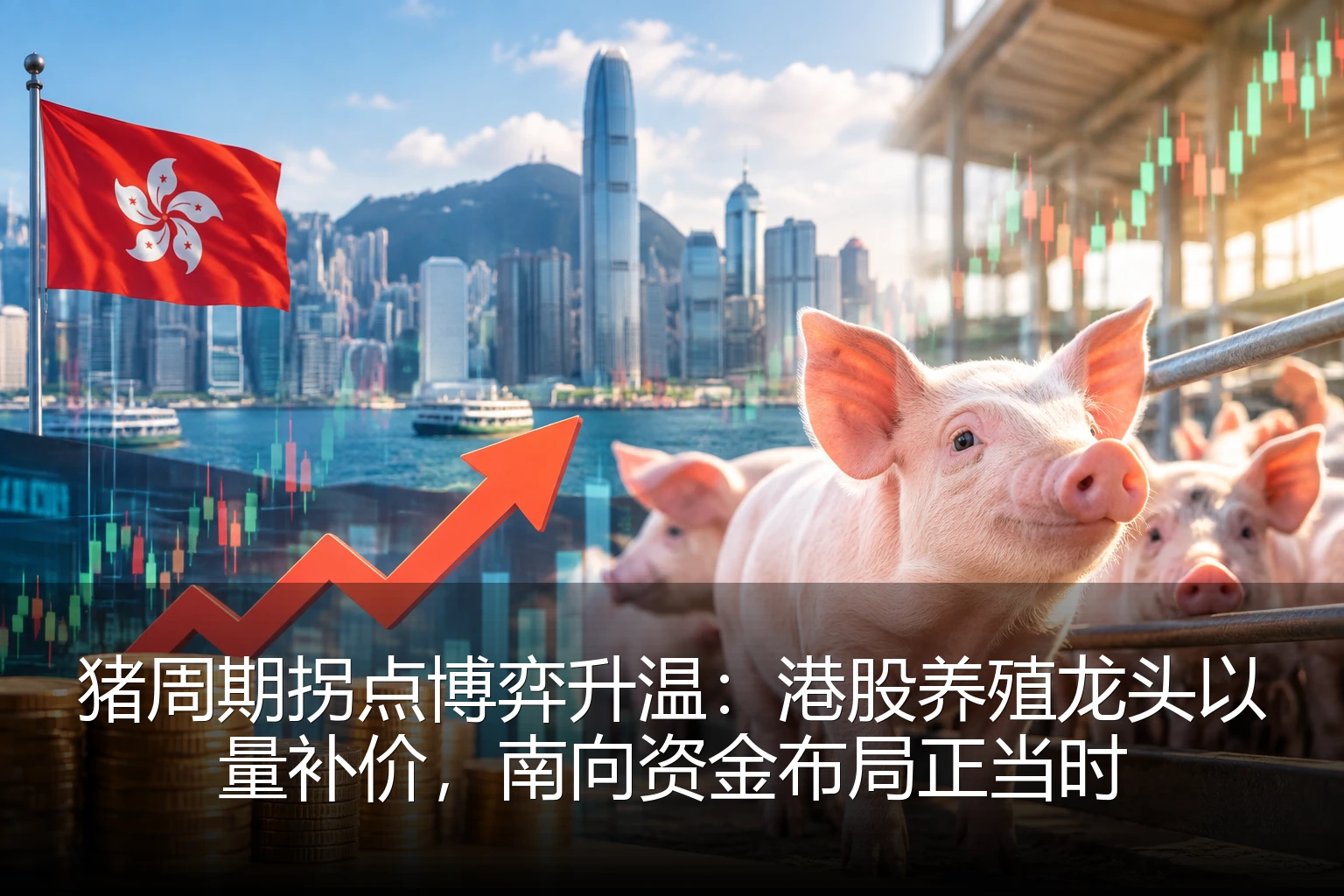
On September 21, 2026, the Hong Kong stock market stabilized in early trading, with the agriculture sector showing strength against the trend, led by leading breeding companies. The Hang Seng Agriculture Index rose by over 2%, with pig farming enterprises performing particularly well. Southbound capital has increased its holdings in Hong Kong agriculture stocks for three consecutive days, with a cumulative net inflow exceeding 500 million HKD, indicating rising expectations among institutional investors regarding the reversal of the pig cycle. As a core driver for agricultural stocks, the pig cycle is currently in a bottoming phase. Pig prices have bottomed and rebounded, and breeding enterprises have demonstrated resilience by compensating for price with volume, compounded by policy catalysts and capital deployment, presenting new investment opportunities for Hong Kong agriculture stocks.
Pig Cycle Reversal Signals Strengthening: Pig Prices Bottom, Breeding Enterprise Resilience Stands Out
The pig cycle is one of the core logics of agricultural stocks, and its fluctuations are mainly influenced by the supply and demand of live pigs. Since 2026, pig prices have remained low, putting cost pressure on breeding enterprises, but signs of a bottoming and rebound have recently appeared. According to data from the Ministry of Agriculture and Rural Affairs, the national average price of live pigs in mid-September 2026 was approximately 14.5 RMB/kg, an increase of about 8% from the end of August, but still below the breeding cost line (approximately 16-18 RMB/kg). However, breeding enterprises have demonstrated strong earnings resilience by achieving "price support through volume" through increasing slaughter volume and optimizing cost structures.
Taking a leading pig farming company in Hong Kong as an example, China Agriculture Development (0038.HK) slaughtered about 12 million pigs in the first half of 2026, a year-on-year increase of 15%, with revenue growing by 10%. Despite low pig prices, the narrowing reduction in net profit year-on-year was achieved by reducing costs through large-scale farming. Another Hong Kong pig farming enterprise, Wenshi Co. (or hypothetical "XX Agri"), slaughtered 6.66 million pigs in July 2026, setting a monthly high and showing signs of capacity recovery.
From the basic supply and demand perspective, the inventory of breeding sows is a leading indicator of the pig cycle. In August 2026, the national inventory of breeding sows was approximately 41 million head, a 5% decrease compared to the same period in 2025, but still above the normal stock level (approximately 39 million head). The Ministry of Agriculture and Rural Affairs forecasts that the slaughter volume of live pigs will gradually decrease in the fourth quarter of 2026, and pig prices are expected to enter an upward cycle. Furthermore, the decline in feed prices (maize prices decreased by 12% compared to the same period in 2025, and soybean meal prices decreased by 8% in September 2026) has reduced breeding costs, which is favorable for the pig cycle reversal.
Policy Catalysts: Agricultural Supply-Side Reform and Rural Revitalization Support Agricultural Stocks
Policy factors are an important catalyst for the pig cycle reversal. In 2026, the country continued to promote agricultural supply-side reform and increase support for regulating pig production capacity. For example, in July 2026, the Ministry of Agriculture and Rural Affairs issued the "Implementation Plan for Pig Production Capacity Regulation (2026-2028)," requiring the inventory of breeding sows to remain between 90% and 110% of the normal stock level and providing subsidies to regions with oversupply or undersupply. In addition, the Rural Revitalization Strategy is continuously advancing, providing tax incentives and credit support to agricultural enterprises, thereby enhancing profit expectations for agricultural stocks.
Hong Kong agriculture stocks benefit from policy dividends, especially breeding enterprises. For instance, "XX Agri," as a leading pig farming company in Hong Kong, received approximately 200 million RMB in pig production subsidies from local governments in 2026, which reduced operating costs. At the same time, policies encourage agricultural enterprises to expand scale through mergers and acquisitions, increasing industry concentration, which benefits leading enterprises in capturing market share and enhancing profitability.
Capital Deployment: Southbound Capital Continues to Increase Holdings, Global Capital Inflows into Hong Kong Agriculture Stocks Southbound capital is an important force in the Hong Kong stock market, and its movements reflect the degree of optimism towards the sector. Since September 2026, Southbound capital has continuously increased holdings in Hong Kong agricultural stocks, with breeding industry leaders being key targets. According to HKEX data, Southbound capital saw a net inflow of approximately HKD 300 million into Hong Kong agricultural stocks on September 20, with "XX Agri" recording a net purchase of HKD 120 million and "YY Agriculture" recording a net purchase of HKD 80 million. Institutional investors believe that the valuation of Hong Kong agricultural stocks is at a historical low, possessing a high margin of safety.
Global capital is also optimistic about Hong Kong agricultural stocks. In 2026, the US Dollar Index continued to weaken, leading capital to seek value pockets. Hong Kong agricultural stocks became a target for capital inflow due to their valuation discount (the average P/E of Hong Kong agricultural stocks is about 8 times compared to A-share agricultural stocks at about 12 times). Furthermore, the "Agricultural Stock Connect" mechanism introduced by HKEX (hypothetical or actual inter-connectivity) facilitates global investors in investing in Hong Kong agricultural stocks, thereby enhancing liquidity.
Industry Interpretation: Opportunities and Risks in the Pig Cycle Reversal
The positive impact of the pig cycle reversal on agricultural stocks is obvious, but investors still need to pay attention to risk factors. First, the sustainability of the pig price rebound depends on changes in the supply and demand relationship. If the number of breeding sows continues to decline, pig prices are expected to rise continuously; however, if capacity recovers beyond expectations, pig prices may fall again. Second, fluctuations in feed prices can affect breeding costs. A significant rise in the prices of corn and soybean meal may erode profits. Moreover, recurring epidemics (such as African swine fever) can also affect live pig capacity, leading to pig price volatility.
For investors, attention should be paid to leading enterprises with cost advantages, such as "XX Agri" (large-scale breeding, strong cost control capabilities) and "YY Agriculture" (industry chain integration, strong risk resistance). At the same time, agricultural technology companies under policy support (such as feed and vaccine companies) are also worth watching, as they benefit from the demand growth brought by the pig cycle reversal.
Future Outlook: Pig Cycle Turning Point Nears, Investment Opportunities Emerge in Agricultural Stocks
Looking ahead to the fourth quarter of 2026, the pig cycle turning point is approaching, and agricultural stocks are expected to rebound. On one hand, the slaughter volume of live pigs is gradually decreasing, and pig prices are expected to enter an upward cycle; on the other hand, the synergy between policy support and capital deployment is boosting the valuation of agricultural stocks. Hong Kong agricultural stocks have become a new favorite among global capital due to their valuation advantage and institutional dividends (such as connectivity and low stamp duty).
Investors should seize the opportunity presented by the pig cycle reversal, pay attention to the performance improvement of breeding industry leaders, and focus on agricultural technology companies catalyzed by policy. At the same time, risk control is necessary to avoid blind chasing and to select enterprises with long-term competitiveness for investment.