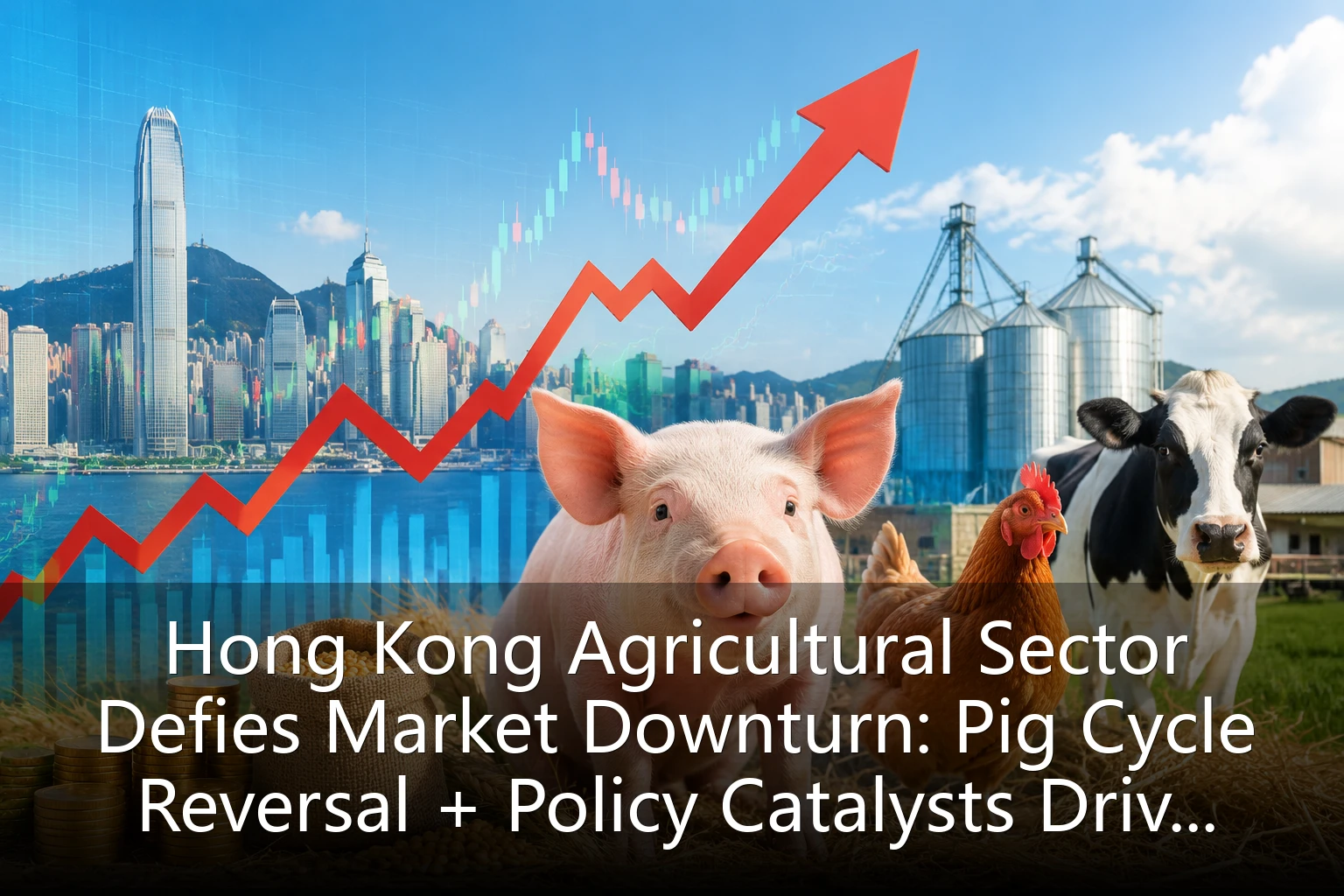
On August 9, 2026, the Hong Kong stock market showed overall volatility, but the agricultural sector bucked the trend, becoming a focal point for capital. Amid expected pig cycle reversal and dual policy benefits, Hong Kong agricultural stocks, particularly leading livestock companies, performed strongly, attracting significant southbound capital inflows. This article will provide an in-depth analysis of the investment logic, market performance, and future outlook of Hong Kong's agricultural sector.
\n\nMarket Performance of the Resilient Hong Kong Agricultural Sector
\n\nAs of the close on August 9, 2026, the Hang Seng Index fell slightly by 0.32%, but the agricultural sector index rose by 1.8%, outperforming the broader market. Among these, the hog farming sector showed the most significant increase, with an average gain of over 3%. Leading companies such as Muyuan Foods and Wens Foodstuffs reached recent highs in stock prices, while Hong Kong-listed agricultural enterprises like Dekang Agriculture and New Hope also strengthened.
\n\nIn terms of trading volume, agricultural sector trading increased by approximately 25% compared to the previous trading day, indicating a significant rise in market activity. Southbound funds have net bought Hong Kong agricultural stocks for three consecutive days, with cumulative net purchases exceeding 1.5 billion Hong Kong dollars, with particularly notable allocations to leading hog farming enterprises.
\n\nExpected Pig Cycle Reversal Drives Sector Strength
\n\nCurrently, hog prices have fallen below the cost line, and the industry has entered a deep adjustment period. According to the latest data, the national average hog price has dropped to 14.5 yuan per kilogram, a decrease of over 30% from the beginning of the year's high, with most farming companies operating at a loss. However, the market generally believes that hog prices have approached the bottom and a reversal is imminent.
\n\nFrom a cyclical perspective, the hog farming industry exhibits distinct cyclical characteristics, typically completing a full cycle every 3-4 years. Since reaching its cyclical high in 2022, hog prices have been continuously declining for nearly two years, with capacity reduction reaching historical levels. According to data from the Ministry of Agriculture and Rural Affairs, the breeding sow inventory has decreased by approximately 20% from the 2022 peak, approaching the industry-recognized capacity balance line.
\n\nFurthermore, from a supply-demand perspective, as domestic consumption recovery and hog capacity reduction continue, the future supply-demand outlook is expected to improve. Multiple securities research reports indicate that the hog industry is likely to experience a cyclical reversal in the second half of 2026, with hog prices gradually recovering and the profitability of related companies subsequently improving.
\n\nIndustry Leaders Lead the Sector Recovery
\n\nAgainst the backdrop of expected pig cycle reversal, industry leaders are expected to benefit first, leveraging their scale advantages and cost control capabilities. Taking Muyuan Foods as an example, as the world's largest hog farming enterprise, its hog output reached 6.66 million heads in the first half of 2026, a year-on-year increase of 15%, further enhancing its market share. Despite falling hog prices, the company maintained relatively stable profitability through its integrated farming model and cost advantages.
\n\nHong Kong-listed Dekang Agriculture has also performed impressively recently, having successfully issued $100 million in zero-coupon convertible bonds to expand its farming scale. The company's management stated that the current timing is ideal for bottom-fishing in the industry, and it will seize market share through counter-cyclical expansion.
\n\nPolicy Support Drives Long-term Development of the Agricultural Sector
\n\nIn addition to the expected pig cycle reversal, policy factors also provide strong support for the agricultural sector. In recent years, the state has attached great importance to food security and agricultural modernization, introducing a series of policy measures to support agricultural development. Since 2026, the intensity of related policies has further increased, providing long-term development momentum for the agricultural sector.
\n\nFirst, the rural revitalization strategy continues to advance, with the Ministry of Agriculture and Rural Affairs releasing the "14th Five-Year Plan for Agricultural and Rural Modernization," explicitly calling for accelerating the modernization of agriculture and rural areas and improving the quality, efficiency, and competitiveness of agriculture. This will drive the coordinated development of the agricultural industry chain, creating broad market space for related enterprises.
\n\nSecond, the agricultural supply-side structural reform continues to deepen, promoting the high-quality development of agriculture. By optimizing the industrial structure, improving product quality, strengthening brand building, and other measures, the quality and efficiency of the agricultural supply system are enhanced. This will help agricultural leaders with core competitiveness further expand their market share.
\n\nAdditionally, agricultural science and technology innovation is accelerating. The Ministry of Agriculture and Rural Affairs, in conjunction with the Ministry of Science and Technology, released the "Agricultural Science and Technology Innovation Action Plan," explicitly calling for strengthening the research and development of key core agricultural technologies and promoting self-reliance in agricultural science and technology. This will help agricultural technology companies enhance their core competitiveness and achieve high-quality development.
\n\nSouthbound Funds Position in Hong Kong Agricultural Stocks
\n\nNotably, southbound funds have recently accelerated their inflow into Hong Kong agricultural stocks, demonstrating recognition of the long-term value of the agricultural sector. According to data from the Hong Kong Stock Exchange, since 2026, southbound funds have cumulatively net bought over 10 billion Hong Kong dollars worth of Hong Kong agricultural stocks, accounting for approximately 15% of the total trading volume in the sector during the same period.
\n\nFrom an investment perspective, southbound funds are mainly optimistic about several aspects of the agricultural sector: first, the agricultural sector valuation is at a historical low, offering a high safety margin; second, the expectation of pig cycle reversal is clear, and the profitability of related companies is expected to improve; third, policy support is increasing, and the long-term development prospects of the agricultural sector are favorable; fourth, the Hong Kong market has abundant liquidity and flexible trading mechanisms, facilitating capital inflows and outflows.
\n\nMany market analysts have stated that southbound funds' positioning in agricultural stocks is not a short-term behavior but based on recognition of the long-term value of the agricultural sector. With the acceleration of agricultural modernization and the deepening of the rural revitalization strategy, the agricultural sector is expected to offer long-term investment opportunities.
\n\nInvestment Opportunities and Risks in Hong Kong's Agricultural Sector
\n\nInvestment Opportunities
\n\nIn terms of investment opportunities, Hong Kong's agricultural sector mainly offers the following investment opportunities:
\n\n- \n
- Hog farming sector: As the expected pig cycle reversal gradually materializes, the profitability of hog farming companies is expected to improve, especially for leading enterprises with scale advantages and cost control capabilities. \n
- Dairy sector: With consumption upgrading and increasing health awareness, the demand for dairy products continues to grow, and dairy companies with brand advantages and channel strengths are expected to benefit. \n
- Agricultural technology sector: Accelerated innovation in agricultural science and technology presents development opportunities for agricultural technology companies with core technologies and R&D capabilities. \n
- Agricultural product processing sector: With the deepening of agricultural supply-side structural reform, agricultural product processing companies are expected to enhance profitability through industry chain integration and product upgrading. \n
Risk Factors
\n\nAlthough Hong Kong's agricultural sector offers abundant investment opportunities, certain risk factors require investors' attention:
\n\n- \n
- The timing of the pig cycle reversal is uncertain, and if capacity reduction falls short of expectations, the hog price rebound may be delayed. \n
- Agricultural product prices are highly volatile, affected by various factors such as climate and supply-demand relationships, which may lead to unstable corporate profitability. \n
- The agricultural sector is significantly influenced by policy changes, which may have a major impact on corporate operations. \n
- The Hong Kong market experiences significant volatility, notably affected by international market sentiment and capital flows, requiring investors to pay attention to exchange rate risks and market risks. \n
Future Outlook
\n\nLooking ahead, Hong Kong's agricultural sector is expected to encounter structural opportunities under the dual benefits of expected pig cycle reversal and supportive policies. On one hand, as hog capacity reduction continues, hog prices are expected to gradually recover, and the profitability of related companies will improve accordingly. On the other hand, the deepening implementation of the rural revitalization strategy and agricultural supply-side structural reform will provide long-term development momentum for the agricultural sector.
\n\nFrom an investment strategy perspective, investors are advised to focus on agricultural leaders with core competitiveness and growth potential, especially in sub-sectors like hog farming, dairy, and agricultural technology. At the same time, attention should be paid to the progress of pig cycle reversal and policy changes to adjust investment strategies in a timely manner.
\n\nOverall, Hong Kong's agricultural sector is currently valued at historical lows, offering a high safety margin and investment value. Under the dual benefits of expected pig cycle reversal and supportive policies, Hong Kong's agricultural sector is expected to usher in a new round of upward momentum, and investors may appropriately consider related investment opportunities.